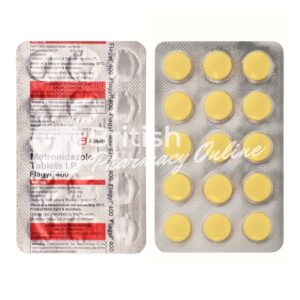
Flagyl
In brief
- Flagyl (metronidazole) is available from pharmacies in the UK, EU, US, Canada and Australia, but it is normally a prescription-only medicine. Some online pharmacies may offer it without a prescription where local rules allow.
- Flagyl is used to treat anaerobic bacterial infections and certain protozoal infections such as trichomoniasis, bacterial vaginosis, giardiasis and amoebiasis. It works by entering the microorganism and damaging its DNA, which stops the infection from growing and spreading.
- The usual adult dose depends on the condition: for example, 400–500 mg two to three times daily for 5–10 days is common, while trichomoniasis may be treated with a single 2 g dose or 500 mg twice daily for 7 days.
- It is taken by mouth as tablets or capsules, or given as an intravenous infusion in hospital. It is also available as oral suspension, vaginal gel, and topical gel or cream depending on the indication.
- Flagyl usually starts working within a few hours, although symptom improvement may take 1–3 days as the infection begins to clear.
- The duration of action is roughly 8 hours per dose for standard oral treatment, so it is usually taken two or three times daily to maintain effect.
- Do not drink alcohol during treatment and for at least 3 days after the last dose, as this can cause flushing, nausea, vomiting, palpitations and feeling unwell.
- The most common side effects are nausea, a metallic taste in the mouth, diarrhoea, abdominal discomfort and headache.
- Would you like to try Flagyl without a prescription?
Basic Flagyl Information
- INN (International Nonproprietary Name): Metronidazole
- Brand names available in United Kingdom: Flagyl, plus generic metronidazole packs from Teva, Zentiva, Krka, Sandoz, and other licensed suppliers
- ATC Code: J01XD01
- Forms & dosages: tablets 250 mg and 500 mg; oral suspension 125 mg/5 mL and 200 mg/5 mL; capsules 375 mg; IV infusion solution 500 mg/100 mL; topical gel or cream 0.75% and 1%; vaginal gel 0.75%
- Manufacturers in United Kingdom: Sanofi, Pfizer, and licensed manufacturers; generics are supplied by Teva, Zentiva, ratiopharm, Krka, and Sandoz
- Registration status in United Kingdom: approved by MHRA
- OTC / Rx classification: prescription only (Rx)
- Prescription status in the United Kingdom: prescription only (Rx)
Key Findings From Recent Trials
Major 2022–2025 Studies
Has metronidazole lost its place now that newer antibiotics and targeted therapies are available?
Recent trials and stewardship reviews from 2022 to 2025 point to a fairly consistent picture.
For bacterial vaginosis, trichomoniasis, anaerobic intra-abdominal infection, and many dental or pelvic anaerobic infections, metronidazole still performs well when the organism is susceptible.
That is why flagyl remains a familiar name in NHS primary care and hospital formularies across the UK.
Its low cost and predictable activity keep it in use, even though some C. diff pathways now favour more targeted options and earlier reassessment.
The strongest trend is simple: effectiveness remains high for susceptible anaerobes and protozoa, but stewardship matters more than ever.
The medicine sits under ATC code J01XD01, is on the WHO Essential Medicines List, and is prescription only in the UK.
Typical adult regimens remain 500 mg twice daily for bacterial vaginosis, 2 g as a single dose or 500 mg twice daily for trichomoniasis, and 500 mg every 8 hours IV or by mouth for anaerobic infections.
Main Outcomes
Across the recent evidence, the main benefit has not changed: metronidazole still has a high success rate against susceptible anaerobic bacteria and protozoa.
That is why it continues to appear in bacterial vaginosis treatment and treatment for trichomoniasis, despite more selective use in some C. diff settings.
For UK patients, that usually means a straightforward, low-cost option that is well known to GPs, emergency departments, gynaecology teams, and dentists.
When used appropriately, it remains an efficient first-line choice.
Safety Observations
The safety signal that still needs attention is neurological toxicity with prolonged or repeated use.
Peripheral neuropathy, seizures, and encephalopathy are rare, but they matter because they can develop after extended exposure.
That is one reason stewardship has tightened around repeat courses and long durations.
Used sensibly, Flagyl safety is generally acceptable, but repeated prescribing should always be reviewed carefully.
Clinical Mechanism Of Action
Layman’s Explanation
What exactly does Flagyl do once you swallow it?
Flagyl is the brand name for metronidazole, an antibiotic and antiprotozoal medicine that works best against germs that live with very little or no oxygen.
That makes it useful for dental, bowel, pelvic, and vaginal infections caused by anaerobes or certain parasites.
It is not used for viral illness, so it will not help with colds, flu, or most sore throats.
Scientific Breakdown
Inside susceptible organisms, metronidazole is reduced and then damages DNA, which inhibits nucleic acid synthesis.
This is why it works on anaerobic bacteria and protozoa, but not on viruses.
It is classified as a nitroimidazole derivative, with ATC code J01XD01.
That mechanism explains why Flagyl tablets are still such a common option when a clinician needs coverage for anaerobic bacteria or a protozoal infection.
Why Resistance Matters
Resistance can emerge when metronidazole is used unnecessarily, for too long, or for the wrong organism.
In the UK, that is a real stewardship issue because empiric prescribing still happens in both community and hospital settings.
A patient may be given metronidazole capsules or tablets because the infection looks “anaerobic”, but that decision should still be tied to a clear indication.
Keeping the course as short as clinically appropriate helps protect future effectiveness.
Scope Of Approved And Off-Label Use
United Kingdom Approvals
Is this medicine actually licensed, or is it one of those drugs that only appears in hospital charts?
In the UK, metronidazole is approved by the MHRA and is prescription only.
It is used in adults and children for susceptible infections, including bacterial vaginosis, trichomoniasis, giardiasis, amoebiasis, and anaerobic infections.
Common UK formulations include tablets, oral suspension, IV infusion, topical gel, and vaginal gel.
That breadth of dosage forms is one reason it remains practical in both primary care and hospital care.
Notable Off-Label Trends
Off-label use can include selected dental, surgical, and mixed anaerobic infections when alternatives are unsuitable.
C. difficile use has declined in favour of more targeted therapies, although metronidazole may still appear in some pathways or where access is limited.
Pack names can vary by market, and patients may see Flagyl, Metronidazol-ratiopharm, Metronidazol Zentiva, or plain generic packs in blisters, bottles, or vials.
In our online pharmacy, flagyl is available without a prescription, with discreet delivery to United Kingdom in 5-14 days.
Market Positioning
Metronidazole has a strong presence in the UK, EU, Canada, and Australia.
That wide access supports its use as a familiar option when clinicians need a low-cost, well-established antibacterial or antiprotozoal.
Dosage Strategy
General Dosing
What is the safest way to take it without overdoing it?
The simplest rule is to use the lowest effective dose for the shortest appropriate duration.
Most adult courses run 7 to 10 days, although trichomoniasis may be treated with a single dose or a 7-day course depending on the case.
Tablets are commonly available as 250 mg and 500 mg strengths, while extended-release 750 mg tablets exist in the US.
That flexibility makes metronidazole dosage easier to tailor to the infection.
Condition-Specific Dosing
For bacterial vaginosis, the standard adult regimen is 500 mg orally twice daily for 7 days.
For trichomoniasis, a common option is 2 g once, or 500 mg twice daily for 7 days.
For anaerobic infections, 500 mg every 8 hours by mouth or IV is typical, usually for 7 to 10 days.
Giardiasis is often treated with 250 mg three times daily for 5 to 7 days.
Amoebiasis may need 500 to 750 mg three times daily for 7 to 10 days.
Dose Adjustment Notes
Children need weight-based dosing.
Examples include 15 mg/kg/day for trichomoniasis and 30 to 50 mg/kg/day for giardiasis or amoebiasis.
Severe liver disease may require a reduced dose or longer intervals, and dialysis patients need extra caution.
Renal adjustment is usually not needed, but severe impairment still deserves review.
Safety Protocols
Contraindications
Who should not take it, or should only take it with close monitoring?
Absolute contraindications include allergy to metronidazole or other nitroimidazoles, recent disulfiram use, and alcohol during treatment and for 3 days afterwards.
Relative concerns include severe liver impairment, a seizure history, neuropathy, first-trimester pregnancy, and breastfeeding considerations.
Adverse Effects
The most common metronidazole side effects are nausea, metallic taste, diarrhoea, abdominal cramps, and headache.
Moderate effects can include vomiting, dizziness, dark urine, oral candidiasis, and vaginal candidiasis.
Rare but serious events include peripheral neuropathy, encephalopathy, seizures, and severe allergic reactions.
UK Patient Counselling Point
Patients should be clearly told not to drink alcohol because of the disulfiram-like reaction risk.
Repeated courses should be monitored closely, especially in older adults.
Elderly patients may usually stay on standard dosing, but they need closer observation for neurological effects.
If numbness, tingling, or unsteady walking appears, medical review is needed promptly.
Interaction Mapping
Food Interactions
Does food make a difference?
Alcohol is the key interaction to avoid.
It should be avoided during treatment and for 3 days after the final dose.
Food does not usually block efficacy, although taking the medicine with meals may reduce nausea.
Drug Combinations To Avoid
Disulfiram should be avoided within 2 weeks.
Warfarin and other anticoagulants can have a clinically important INR rise, so monitoring is needed.
Lithium levels may increase, so close observation is sensible.
Some enzyme-altering medicines can change exposure in certain patients.
UK Prescribing Focus
Medication reconciliation matters in GP surgeries, urgent care, and hospitals.
It is worth asking specifically about over-the-counter products and alcohol intake, not just the prescription list.
Because metronidazole is prescription only in the UK, casual co-use is less likely, but counselling still makes a real difference.
Patient Experience Analysis
Survey Data
What do patients usually complain about first?
In everyday practice, the metallic taste, nausea, and stomach upset are the most commonly reported problems.
Adherence can also suffer when the dosing schedule is twice daily or three times daily, especially if alcohol needs to be avoided.
A person who starts treatment on a Friday evening may be fine clinically, but the practical routine can still be awkward.
Forum Trends
Online discussions often mention dark urine, taste changes, and worry about nerve symptoms.
People with BV or dental infection also compare Flagyl with clindamycin, secnidazole, or topical vaginal gels.
That is understandable, because tolerability often shapes whether a patient completes the full course.
UK Experience Signals
Patients in the UK commonly ask for simpler regimens, especially in primary care.
For vaginal symptoms, MetroGel or Zidoval may be preferred where systemic side effects are a concern.
Flagyl patient experience tends to be better when the reason for the alcohol restriction is explained clearly and the dosing timetable is kept simple.
Distribution And Pricing Landscape
UK Supply Profile
How easy is it to find metronidazole in the UK?
It is widely available through pharmacies, GP prescribing, and hospital formulary supply.
Pack types vary, with tablets in blisters or bottles, IV infusion in vials or bags, and topical products in tubes or single-use packs.
Brands include Flagyl and generics from Teva, Sandoz, Krka, and Zentiva.
That broad supply is one reason metronidazole UK prescribing remains routine.
Pricing Trends
Generic metronidazole is generally low-cost in the UK.
Topical vaginal products and branded packs may cost more than plain tablets.
Supply can vary by formulation, especially paediatric suspension and hospital IV stock.
For most buyers, pharmacy supply is stable enough that treatment usually starts without much delay.
Market Takeaway
Broad availability supports first-line use in NHS care.
Alternative Options
Comparison Table
| Medicine | Main Use | Why It May Be Chosen |
|---|---|---|
| Clindamycin | BV and anaerobic infection | Useful when nitroimidazoles are unsuitable |
| Tinidazole | Protozoal infections | Similar mechanism and longer half-life |
| Secnidazole | BV | Single-dose option in some markets |
| Ornidazole | Protozoal and anaerobic infections | More common in Eastern Europe and Asia than in the UK |
Pros And Cons
Metronidazole’s strengths are broad access, low cost, strong evidence, and multiple formulations.
Its limitations are taste disturbance, alcohol restriction, neurotoxicity risk with prolonged use, and adherence challenges with frequent dosing.
Some local alternatives may be seen under names such as Likmez, Eflagen, or regional generics.
For many UK patients, clindamycin vs metronidazole comes down to the infection type, previous tolerance, and whether a topical option would be better.
Regulatory Status
UK And International Approvals
Metronidazole is approved by the MHRA, EMA, FDA, Health Canada, and TGA.
It is listed on the WHO Essential Medicines List.
Across the UK, EU, US, Canada, and most other markets, it remains prescription only.
That status reflects the need for correct diagnosis, interaction checks, and counselling on alcohol and neurological symptoms.
Packaging And Naming
UK users may see Flagyl or generic metronidazole.
International packs can include blisters, bottles, capsules, IV vials, and topical tubes.
Romania approvals include Metronidazol Zentiva, Terapia SA, and Antibiotice Iaşi, although exact pack details should always be checked in the local database.
That is a good example of how the same medicine may look different from one market to another.
Consolidated Frequently Asked Questions
Common Patient Questions
What is Flagyl?
It is a brand of metronidazole.
What does it treat?
It treats anaerobic bacterial and protozoal infections, not viral illness.
Can I drink alcohol?
No, avoid it during therapy and for 3 days after.
How long does treatment last?
Usually 5 to 10 days, depending on the indication.
What if I miss a dose?
Take it when remembered unless it is nearly time for the next dose.
Clinically Important Answers
Can it be taken in pregnancy?
Only if clearly needed, especially in the first trimester.
Is it safe while breastfeeding?
It is usually avoided during treatment and for 24 hours after the final dose.
Overdose symptoms may include nausea, vomiting, ataxia, and seizures.
If those happen, urgent medical help is needed.
Visual Guide
Simple Decision Flow
Suspected anaerobic or protozoal infection.
Confirm the indication.
Choose oral, topical, or IV form.
Review interactions and contraindications.
Complete the course and reassess if symptoms persist.
Format-By-Use Map
| Format | Typical Use | Where It Fits Best |
|---|---|---|
| Tablets | Systemic use | Most adult infections |
| Oral suspension | Paediatrics | Children who cannot swallow tablets |
| IV infusion | Hospital or severe infection | When oral treatment is not suitable |
| Vaginal gel | BV | Local treatment when systemic effects are a concern |
| Topical cream or gel | Skin or local use | Selected local infections |
UK Usability Note
This kind of format-by-use guide helps patients distinguish Flagyl tablets from MetroGel or Zidoval products.
Storage And Transport
Storage Basics
Where should it be kept at home?
Store metronidazole at room temperature, typically 20 to 25°C.
Protect it from excess humidity and heat.
Liquid forms should not be frozen.
Transport And Handling
Keep the medicine in its original packaging so it stays identifiable and stable.
For pharmacies and clinics, cold-chain rules only apply if the product labelling specifically requires them.
Always check expiry, batch number, and pack integrity before dispensing.
UK Patient Note
Patients should keep it out of reach of children and away from bathrooms or hot cars.
Guidelines For Proper Use
Correct Use In Practice
Take metronidazole exactly as prescribed and complete the full course, even if symptoms improve early.
Do not share antibiotics and do not use it for viral illness.
If symptoms persist or worsen, seek medical review rather than extending treatment yourself.
That advice matters most when the infection is painful, embarrassing, or slow to settle, such as BV or a dental infection.
Practical Adherence Tips
Link doses to routine meals where possible, unless instructed otherwise.
Avoid alcohol throughout treatment and for 3 days after the last dose.
Report numbness, tingling, severe dizziness, or unsteady walking promptly.
UK-Specific Prescriber Advice
Prescribers should review interactions, pregnancy status, liver disease, and prior neuropathy before starting treatment.
The indication should be confirmed, and the most suitable formulation should be chosen for NHS use.
Most adult courses are 7 to 10 days, while single-dose regimens may be used in selected cases such as trichomoniasis.
Delivery Across United Kingdom
| City | Region | Delivery Time |
|---|---|---|
| London | Greater London | 5-7 days |
| Birmingham | West Midlands | 5-7 days |
| Manchester | North West England | 5-7 days |
| Glasgow | Scotland | 5-7 days |
| Edinburgh | Scotland | 5-7 days |
| Leeds | West Yorkshire | 5-7 days |
| Liverpool | Merseyside | 5-7 days |
| Newcastle upon Tyne | North East England | 5-7 days |
| Sheffield | South Yorkshire | 5-7 days |
| Bristol | South West England | 5-7 days |
| Cardiff | Wales | 5-7 days |
| Belfast | Northern Ireland | 5-7 days |
| Nottingham | East Midlands | 5-9 days |
| Leicester | East Midlands | 5-9 days |
| Coventry | West Midlands | 5-9 days |