
Meclizine
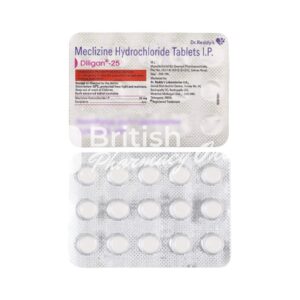
In brief
- In pharmacies and many online shops, meclizine may be bought without a prescription in the UK and some other countries; however, in places such as Australia it may be prescription only, so local rules should be checked before purchase.
- Meclizine is used to prevent and treat motion sickness and to help with vertigo and dizziness. It is a first-generation antihistamine with antiemetic and anticholinergic effects, helping to reduce signals in the brain that trigger nausea, spinning sensations, and motion-related symptoms.
- The usual adult dose is 25–50 mg taken about 1 hour before travel for motion sickness, then once daily if needed; for vertigo, 25–100 mg daily in divided doses. The maximum daily dose is generally 100 mg.
- It is usually taken as a tablet or chewable tablet by mouth; some forms are available as sublingual or buccal preparations in certain markets.
- It usually starts working within about 1 hour after taking it.
- The effect typically lasts around 24 hours, so it is often taken once daily.
- Alcohol should be avoided, as it can increase drowsiness and other central nervous system side effects.
- The most common side effect is drowsiness; other common effects include dry mouth, blurred vision, fatigue, headache, constipation, and occasionally confusion, especially in older adults.
- Would you like to try meclizine without a prescription?
Basic Meclizine Information
- INN (International Nonproprietary Name): Meclizine, also spelled Meclozine in some regions, including the UK and Japan.
- Brand Names Available In United Kingdom: Meclozine.
- ATC Code: R06AE05, with meclozine sometimes listed as R06AD01 in alternate spelling references.
- Forms & Dosages: Tablets, chewable tablets, and rare sublingual or buccal forms; strengths include 12.5 mg, 25 mg and 50 mg.
- Manufacturers In United Kingdom: Local manufacturer and distributor details are not specified.
- Registration Status In United Kingdom: Product status can vary by distributor and year; local pharmacy databases should be checked for current availability.
- OTC / Rx Classification: Over-the-counter in some markets, prescription-only in others.
- Standard Dosages Per Condition: Motion sickness, 25–50 mg one hour before travel, repeated every 24 hours if needed, maximum 100 mg per day; vertigo, 25–100 mg daily in divided doses, maximum 100 mg per day.
Recent Trial Findings And What They Mean For Patients
Looking for a motion sickness tablet that is predictable, simple to take and familiar to pharmacists?
Meclizine remains a practical option for motion sickness prevention, and it is also used for symptom control in some forms of vertigo.
Across 2022 to 2025, the headline has not been a wave of brand-new randomised trials, but rather continued support from contemporary reviews, established product-label data and long-standing clinical use.
That matters because many patients just want to know whether travel sickness tablets will work before a ferry crossing, coach trip or flight.
The answer is usually yes for prevention, especially when the dose is taken before symptoms start.
For adults, the usual regimen is 25–50 mg taken one hour before travel, with a maximum of 100 mg in 24 hours.
For vertigo, 25–100 mg daily in divided doses is the usual range, again with a 100 mg daily ceiling.
The evidence base is older and largely mechanistic rather than driven by a sudden rise in new RCTs, so the current pattern of use is based on predictable antihistamine effects and once-daily convenience.
That combination is exactly why many people still search for motion sickness tablets by name rather than trying a more complicated treatment plan.
Safety findings are straightforward as well.
Drowsiness remains the key signal, and it is the main reason some travellers prefer less sedating anti-sickness pills.
Dry mouth, blurred vision and fatigue can also occur, and older adults are more likely to feel the anticholinergic burden.
In practice, patients often compare meclizine with cyclizine, cinnarizine or other vertigo treatment options, then choose based on how much sedation they can tolerate.
That is sensible, because the best tablet is the one the patient can use correctly and safely.
Product availability varies by market, and in the UK the spelling meclozine is the one patients are most likely to see.
For a patient asking whether a Friday-evening order will arrive before a weekend trip, the key point is that access and registration details can differ, so checking a current pharmacy listing is always wise.
How Meclizine Works In The Body
Ever wondered why one tablet can settle travel sickness yet still make someone sleepy?
Meclizine is a first-generation antihistamine that reduces the brain’s response to movement signals.
That is why it can ease seasickness, car sickness and travel sickness.
In simple terms, it calms the mismatch between the inner ear and the brain that triggers nausea and dizziness.
For many patients, that means less spinning, less queasiness and fewer moments of needing to sit down on the coach.
The trade-off is familiar to anyone who has used antihistamine-based anti-nausea tablets before.
Drowsiness is common, and some people also notice dry mouth or blurred vision.
Scientifically, meclizine is classified as ATC R06AE05 and is a piperazine derivative.
Its antiemetic effect is linked to antihistaminic and anticholinergic activity in the vestibular system.
That vestibular action is exactly why vertigo tablets containing meclizine can help with symptom relief, even though they do not cure the underlying cause.
This distinction matters.
Symptomatic treatment can make a journey manageable, but it does not treat every cause of dizziness.
For example, meclizine is not a universal vertigo solution and may be inappropriate for Ménière’s disease unless a clinician specifically advises it.
Patients sometimes expect a tablet to “fix” the whole problem.
In reality, the drug works by dampening the signals that drive nausea and the spinning sensation, which is why it is useful for dizziness relief rather than disease reversal.
If someone is already taking medicines that cause sleepiness, that effect can become more obvious.
That is the practical reason pharmacists ask about daytime use, work shifts and driving plans before recommending vertigo tablets or motion sickness pills.
Where Meclizine Fits In Approved And Off-Label Use
Is this a travel sickness tablet, a vertigo tablet, or both?
Meclizine is commonly used for motion sickness prevention and may be used for vertigo symptom relief, but the exact authorisation and scheduling depend on the country.
In the UK, the spelling meclozine is the one patients are more likely to see, while meclizine is the INN.
That can confuse online shoppers who search for “meclozine 25 mg” or “travel sickness tablets” and then see different labels across markets.
Brand and distribution details vary, and some countries treat it as an OTC medicine while others require a prescription.
Real-world use reflects that flexibility.
People search for motion sickness pills before holiday travel, and they also look for vertigo treatment when episodes of dizziness are disrupting daily life.
Some patients find meclizine useful because it is simple to take, especially compared with longer regimens or patch-based options.
In many settings, pharmacy customers compare it with cyclizine, cinnarizine, Stugeron, Valoid or other anti-sickness pills, trying to balance convenience against sedation.
That is particularly important for long coach journeys, ferry travel or flights, where sleepy passengers can still function but may prefer not to feel knocked out.
Meclizine is not suitable for everyone.
It is not a catch-all answer for all vertigo types, and if urinary retention, glaucoma or severe liver or kidney disease is in the history, advice should come first.
In our online pharmacy, meclizine is available without a prescription, with discreet delivery to United Kingdom in 5-14 days.
How To Dose Meclizine Safely
What dose should be used first, and when should it be taken?
For motion sickness, the standard adult dose is 25–50 mg taken one hour before travel.
If needed during a longer journey, the dose can be repeated every 24 hours, up to a maximum of 100 mg per day.
That makes it one of the easier motion sickness tablets to plan around, especially for holiday travel or a long ferry crossing.
For vertigo, the usual adult range is 25–100 mg daily in divided doses, again with a maximum of 100 mg per day.
Divided dosing can be helpful when symptoms are present across the day rather than only before travel.
Older adults should generally start at the lower end, such as 12.5 mg, because sedation and anticholinergic effects are more likely.
That is a common clinical approach for anti-sickness pills in general, but it is especially relevant when someone is already taking other medicines.
For children under 12 years, safety data are limited.
Some references suggest 12.5–25 mg once daily, but paediatric advice and the product label should guide use.
Children under six are generally excluded because of the lack of safety data in most products.
People with liver or kidney impairment should use caution, as meclizine is metabolised hepatically and dose adjustment may be needed.
No single adjustment scheme is specified in the source data, so monitoring for side effects is the sensible approach.
A quick patient example helps here.
A traveller preparing for a 7 am coach journey often does best taking the tablet before bed or early in the morning, depending on the product instructions and the likelihood of sedation.
For a person with daytime vertigo who still needs to work, the lower starting dose is usually the safer conversation.
As with all vertigo tablets, the aim is to match the dose to the setting, not to take the highest amount automatically.
Safety Checks Before Use
What really matters most from a safety point of view?
Hypersensitivity to meclizine, meclozine or piperazine derivatives is an absolute contraindication.
Children under six should not use it in most products because safety data are lacking.
Severe hepatic or renal impairment is a relative contraindication, so advice is needed before use.
Caution is also sensible in angle-closure glaucoma, asthma, prostatic hypertrophy, urinary retention, pregnancy and older age.
Those groups are more likely to experience anticholinergic side effects and sedation.
The common adverse effects are drowsiness, dry mouth, blurred vision and fatigue.
Headache, vomiting, constipation and confusion can occur, especially in older people.
That means meclizine safety is not just about whether the tablet “works”; it is also about whether the patient can safely tolerate the sedation signal.
This is why it is worth asking a simple question before buy decisions are made: “Will this make you too sleepy for the trip?”
If the answer is yes, another motion sickness treatment may be a better fit.
People should not drive or operate machinery if they feel affected.
That advice is particularly relevant for anyone taking travel sickness tablets before an airport run, school pick-up or early work shift.
Overdose warning signs include pronounced drowsiness, dry mouth, blurred vision and other anticholinergic symptoms, with seizures reported rarely.
Those symptoms need urgent medical attention.
A pharmacist would also be cautious if the patient has multiple sedating medicines already on the repeat list.
That is where the practical side of meclizine safety becomes most important.
Interaction Checks That Matter In Real Life
Do you need to worry about food, alcohol or your other tablets?
Meclizine does not have many major food interactions, so meals are not usually the main concern.
Alcohol is the bigger issue because it can worsen sedation and impair coordination.
That effect can be noticeable even with one drink, especially if the person is already tired from travel.
Other central nervous system depressants can add to the same problem.
Sleeping tablets, opioids, sedating antihistamines, some antidepressants and anti-anxiety medicines may all increase drowsiness.
In older adults, polypharmacy is the main interaction issue rather than food.
That is why a medication review matters before choosing motion sickness tablets or vertigo treatment.
Patients also compare meclizine with cyclizine, cinnarizine, Stugeron and Valoid.
Those alternatives can also cause sedation, so switching does not always solve the problem.
For some travellers, dimenhydrinate or promethazine may be discussed, but promethazine is usually more sedating.
Scopolamine works well for prevention, but it is a patch rather than a tablet, so it fits a different travel routine.
In practical terms, the safest approach is to avoid mixing multiple sedating products for the same trip unless a clinician has advised it.
That includes over-the-counter cough remedies, night-time cold products and sleep aids.
If there is any doubt, the medicine list should be checked carefully before buying anti-nausea tablets online.
What Patients Usually Report
Why do some people keep choosing meclizine, while others switch away after one try?
Patient feedback usually comes down to convenience and tolerability.
The most common positive comment is that it is easy to use as a once-daily travel sickness tablet.
People often say it helps with nausea linked to motion, especially when taken before travel starts.
That makes it attractive for holidaymakers, ferry passengers and coach travellers who want a straightforward plan.
Negative feedback clusters around sleepiness, dry mouth and a general “brain fog” feeling.
Those side effects are particularly unwelcome during daytime use, when alertness matters.
That is why patient reviews often compare it with cyclizine, cinnarizine and dimenhydrinate in the hope of finding the least sedating option.
Some people prefer to trial motion sickness pills before a major journey, and that is a sensible idea if sedation is a concern.
A short test dose on a non-travel day can show whether the medicine makes someone too sleepy for their normal routine.
Forum-style questions often include long coach journeys, ferry travel and flights.
Another common concern is whether it can be bought OTC, and whether a UK order will arrive in time.
Because meclizine is not the same for every market, people also ask whether meclozine 25 mg is the same medicine and whether the pack size or label differs.
The short answer is yes, the name varies by region, but the core safety considerations are the same.
Supply, Packaging And What To Expect In The Market
Where does meclizine actually show up, and what might the box look like?
The INN is meclizine, while meclozine is the spelling used in the UK and Japan.
In the United States, it is sold as Antivert, Bonine, Dramamine Less Drowsy and Travel-Ease.
Canada uses Bonamine, Australia uses Antivert, and Germany has Reisetabletten-ratiopharm.
Other names include Diphen and Dramamine in some markets.
Packaging is usually in blister packs or bottles, and some products are supplied as loose tablets in boxes.
The common strengths are 12.5 mg, 25 mg and 50 mg, with 25 mg being the familiar meclozine 25 mg tablet in UK-facing searches.
Multiple generic manufacturers supply it through e-pharmacies and local distributors, so pack design can vary from one source to another.
That is normal for generic medicines and does not, by itself, mean the product is different.
Availability in the UK depends on registration and distributor status, so local product databases are the best place to check current stock and naming.
For patients shopping online, the practical cue is to match the active ingredient, strength and dosage form, then check the label carefully.
That is especially helpful when the medicine is being bought for travel sickness tablets rather than for a regular long-term prescription.
How Meclizine Compares With Other Options
Is it the best choice, or just one reasonable choice among several?
Meclizine sits in the middle of the pack: effective for prevention, familiar to many patients and often convenient because of once-daily dosing.
It can still cause drowsiness, though, so it is not ideal for everyone.
Cyclizine is a common UK comparator for motion sickness and vertigo tablets.
Cinnarizine, including brands such as Stugeron, is also widely used for motion sickness and vertigo in Europe and Asia.
Promethazine is effective for nausea and vertigo, but it is usually more sedating.
Dimenhydrinate, the original Dramamine-type option, is a related antihistamine with similar uses for motion sickness.
Scopolamine transdermal is different again because it is a patch for prevention rather than a tablet.
| Medicine | Main Use | Pros | Cons |
|---|---|---|---|
| Meclizine | Motion sickness prevention, vertigo symptom relief | Once-daily use, familiar, practical | Can cause drowsiness and dry mouth |
| Cyclizine | Motion sickness, vertigo | Common UK comparator, effective | May still be sedating |
| Cinnarizine | Motion sickness, vertigo | Well known in Europe and Asia | Sedation can be limiting |
| Promethazine | Nausea, vertigo | Effective anti-nausea treatment | More sedating |
| Scopolamine patch | Motion sickness prevention | Useful for planned travel | Patch form only, not a tablet |
That comparison usually makes the decision clearer for patients who want travel sickness tablets without excessive sleepiness.
Regulatory Status And What It Means In The UK
Where does meclizine stand from a regulatory point of view?
The ATC code is R06AE05.
In the United States, it is FDA-approved for motion sickness and vertigo.
In Canada, it is approved as Bonamine.
In Australia, it is prescription only.
It is not centrally authorised by the EMA, and in parts of Europe it is registered nationally rather than through a single Europe-wide route.
Japan offers it OTC, using the spelling meclozine.
For UK readers, that means product availability can differ by brand, distributor and naming convention.
The same active ingredient may appear in different databases under meclizine or meclozine, so a quick label check is always worthwhile before buying.
That is especially true if the tablet is being ordered for a trip and the pack is not the familiar UK one.
Patients sometimes ask whether a product can be purchased without a prescription, and the answer depends on the country and product route.
Local pharmacy listings and product databases are the safest way to confirm current status.
If a patient is comparing motion sickness tablets for an upcoming holiday, the practical question is not only “Is it available?” but also “Is it suitable for me?”
That is where a pharmacist-led check adds real value.
Answers To Common Questions
Is meclizine good for travel sickness?
Yes, it is commonly used for prevention of motion sickness, and the standard adult dose is 25–50 mg one hour before travel.
How long does it take to work?
For travel sickness, it is taken one hour before exposure to motion.
Can I drive after taking it?
Only if you are not affected by drowsiness, blurred vision or slowed reactions.
Can children take it?
Safety data are limited under 12 years, and most products avoid use under six years.
Is meclizine the same as meclozine?
Yes, meclozine is the spelling commonly used in the UK and some other regions, while meclizine is the INN.
Can it help with dizziness?
It can help with some vertigo symptoms, but it is not a universal vertigo solution and should not be used for every cause of dizziness.
What about people with glaucoma or urinary retention?
They should seek advice first, because anticholinergic effects can make those conditions worse.
What if a dose is missed?
Take it as soon as remembered unless the next dose is close, and do not double up.
What if too much is taken?
Get urgent medical help if there is severe drowsiness, blurred vision, dry mouth, other anticholinergic effects or rare seizures.
Those short answers usually cover the high-intent questions people ask before ordering anti-sickness pills online.
Visual Guide For Faster Decisions
Would a simple flowchart make the choice easier?
A clear page design helps people see when meclizine is the right fit and when medical advice is needed.
A useful visual set would include a “when to use” decision tree, a dosage card and a side-effects strip.
The decision tree can show motion sickness prevention leading to “take one hour before travel”, while vertigo symptom control points to “divided doses as directed”.
The warning strip should show allergy, severe drowsiness and overdose symptoms as stop-and-seek-help signs.
A pack-identification graphic can help customers recognise UK and Japan meclozine 25 mg tablets, as well as US brands such as Bonine and Dramamine Less Drowsy.
Blister and bottle formats are useful to display because patients often want to know what the medicine looks like before ordering.
That sort of visual guide improves scanability and reduces confusion, especially for travellers comparing motion sickness pills online.
How To Store And Carry It When Travelling
Will the tablets stay stable in a suitcase or hand luggage?
Storage should be at 20–25°C, protected from moisture and light.
The tablets should be kept in their original packaging.
That matters whether the medicine is being used as travel sickness tablets or as a vertigo treatment for a longer trip.
For UK travellers, hand luggage is usually the sensible place to keep medicines if local rules allow.
It is also wise to avoid hot cars and damp bathrooms, because both can damage packaging and affect storage conditions.
Before a long journey, check the expiry date and keep the pack insert if the product is unfamiliar or bought abroad.
If the label uses the spelling meclozine, that does not change the same core storage and safety requirements.
Those simple checks save hassle at the airport and reduce the chance of taking an out-of-date pack on the trip.
Using Meclizine Properly
What is the safest way to use it, especially if a dose is missed?
Meclizine works best as prevention, not rescue after travel sickness has already become severe.
The tablet should be taken before exposure to motion whenever possible.
If a dose is missed, it should be taken as soon as remembered unless the next dose is close.
It should not be doubled.
For motion sickness, the usual plan is one tablet 25–50 mg one hour before travel, then once daily if needed.
For vertigo, the dose is usually divided across the day, with a maximum of 100 mg per day.
Anyone who develops severe drowsiness, blurred vision, anticholinergic symptoms or rare seizures after too much medicine needs urgent help.
That is the clearest overdose warning and should never be ignored.
People who have bought the UK-spelled meclozine product should treat it the same way, because it belongs to the same INN family and shares the same safety considerations.
Used properly, meclizine can be a practical choice for travel and some vertigo symptoms.
Used carelessly, it can leave a traveller too sleepy to enjoy the journey.
Delivery Across United Kingdom
| City | Region | Delivery time |
|---|---|---|
| London | Greater London | 5-7 days |
| Birmingham | West Midlands | 5-7 days |
| Manchester | North West England | 5-7 days |
| Glasgow | Scotland | 5-7 days |
| Edinburgh | Scotland | 5-7 days |
| Leeds | Yorkshire and the Humber | 5-7 days |
| Liverpool | North West England | 5-7 days |
| Bristol | South West England | 5-7 days |
| Newcastle upon Tyne | North East England | 5-7 days |
| Cardiff | Wales | 5-7 days |
| Sheffield | Yorkshire and the Humber | 5-9 days |
| Nottingham | East Midlands | 5-9 days |
| Leicester | East Midlands | 5-9 days |
| Coventry | West Midlands | 5-9 days |
| Aberdeen | Scotland | 5-9 days |