Hydroxyzine
In brief
- Hydroxyzine may be available from some online pharmacies without a prescription, but in the UK and most countries it is normally prescription-only and should be used only under medical supervision. Check local regulations and sourcing carefully.
- Hydroxyzine is used for allergy relief, itching (pruritus), short-term anxiety, and sometimes pre-operative sedation. It is a first-generation antihistamine that works by blocking histamine H1 receptors and also has sedative, anxiolytic and anticholinergic effects.
- The usual adult dose is 25 mg two to three times daily for itching, or 50–100 mg daily in divided doses for anxiety; for sleep, 25–50 mg at bedtime is sometimes used off-label. Doses should be lower in older people, children, and those with kidney or liver impairment.
- Hydroxyzine is available as tablets, capsules, oral solution/syrup, and injectable forms.
- The effect usually begins within 15–30 minutes after an oral dose.
- The duration of action is typically around 4–6 hours, although sedative effects may last longer in some people.
- Avoid alcohol, as it can significantly increase drowsiness, dizziness, and impaired coordination.
- The most common side effect is drowsiness; other frequent effects include dry mouth, fatigue, blurred vision, constipation, nausea, and occasionally palpitations or other heart rhythm problems.
- Would you like to try hydroxyzine without a prescription?
Basic Hydroxyzine Information
- INN (International Nonproprietary Name): Hydroxyzine
- Brand Names Available In United Kingdom: Atarax, Vistaril, and other local and international brand variants, depending on supply and regulatory route
- ATC Code: N05BB01
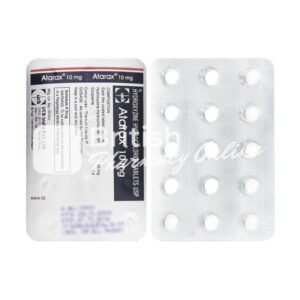
- Forms & Dosages: Tablets 10 mg, 25 mg, 50 mg; capsules 25 mg, 50 mg; syrup/solution 2 mg/ml; injectable 25 mg/ml and 50 mg/ml
- Manufacturers In United Kingdom: Not specified
- Registration Status In United Kingdom: Prescription-only in nearly all markets; EU use is subject to cardiac risk minimisation measures
- OTC / Rx Classification: Prescription-only (Rx)
Key Findings From Recent Trials And Safety Reviews
Are you wondering why hydroxyzine is still discussed so often when there are newer antihistamines on the shelf?
The short answer is that hydroxyzine still has a clear place for itching, short-term anxiety relief and sedation, especially when a faster, more calming effect is needed.
Across recent safety reviews from 2022 to 2025, the big theme has been not whether hydroxyzine works, but how carefully it should be selected and monitored.
Hydroxyzine is a first-generation antihistamine with the ATC code N05BB01, and that older pharmacology explains both its usefulness and its downside.
For hydroxyzine pruritus, the drug can give effective symptomatic relief when itching is troublesome and rapid control matters.
For anxiety, it is sometimes used short term when a clinician wants a non-benzodiazepine option with calming effects.
Its sedative effect also makes it useful when short-term sedation is desired, such as before a procedure or for night-time symptom control.
The main caution in recent European reviews has been QT prolongation and the small but real risk of torsade de pointes, particularly in older adults and people taking several medicines at once.
That is why the EU PRAC-CMDh position has focused on risk minimisation, patient selection and keeping the dose low for the shortest time possible.
In UK practice, hydroxyzine remains prescription-only, which reflects its central nervous system effects and cardiac risk rather than any lack of efficacy.
Common adverse effects still look familiar: drowsiness, fatigue, dry mouth and constipation are the ones patients mention most often.
Rare but serious problems include arrhythmia, QT prolongation and overdose-related central nervous system toxicity, so this is not a medicine to use casually.
In practice, adult pruritus dosing is commonly 25 mg two to three times daily, with a maximum of 100 mg a day, and that ceiling matters.
For many people, hydroxyzine is best thought of as an alternative when non-sedating antihistamines are not enough, or when sedation is actually helpful rather than unwanted.
How Hydroxyzine Works
Ever taken an antihistamine and felt sleepy afterwards, then wondered why that happened?
Hydroxyzine blocks histamine signals that drive itching, sneezing and some allergic symptoms, which is why hydroxyzine for itching can work quickly.
Because it is a hydroxyzine antihistamine from the first generation, it also crosses into the brain more readily than newer options.
That central nervous system penetration is what creates the hydroxyzine sedative effect.
In simple terms, the medicine calms the brain’s histamine-driven wakefulness signal, so drowsiness is a built-in feature rather than an accident.
The scientific description is a first-generation H1 receptor antagonist with central action.
Its anticholinergic activity also contributes to dry mouth, blurred vision and constipation, which are classic older antihistamine effects.
The recognised INN forms are hydroxyzine hydrochloride and hydroxyzine pamoate, and the hydrochloride salt is the one most often discussed in UK-style tablet dosing.
Hydroxyzine’s anxiolytic effect is linked to central calming properties rather than any antidepressant action.
That is why hydroxyzine for anxiety can help some patients feel less keyed up, particularly over a short period, but it is not a long-term psychological treatment.
When someone asks about hydroxyzine hydrochloride 25 mg, the important point is that the dose, the reason for use and the person’s other medicines all matter more than the brand name on the box.
Approved Use And Off-Label Use
What is hydroxyzine actually approved for in the UK setting?
UK practice aligns with hydroxyzine being a prescription medicine used under clinician supervision for allergy-related itching, anxiety and premedication.
Brand availability can vary, and names such as Atarax and Vistaril are often seen in broader international discussions rather than as a guarantee of local supply.
For approved use, the clearest examples are pruritus, anxiety and premedication where a clinician wants a sedating antihistamine.
That makes hydroxyzine tablets relevant when symptom relief is the goal and sleepiness is not a problem.
Off-label use is also common, especially Atarax for sleep and short-term adjunct use in acute anxiety.
People often search for Atarax for anxiety or Atarax for sleep because they have noticed the calming effect and want a medicine that works quickly.
Night-time use for sleep is common, but it remains off-label rather than a formal sleeping tablet indication.
Short-term use in procedural sedation is another real-world trend, especially when a clinician wants rapid calming without moving straight to stronger sedatives.
Hydroxyzine is used less often than non-sedating antihistamines for routine allergy care, but it still has a place when alertness is not the priority.
In our online pharmacy, hydroxyzine is available without a prescription, with discreet delivery to United Kingdom in 5-14 days, which can be helpful for people who need access quickly and want a private ordering process.
Even so, the medicine itself remains one that should be used thoughtfully, because convenience does not remove the need for safe selection.
Dosage Strategy
How much hydroxyzine is usually taken, and for how long?
The guiding principle is simple: use the smallest effective dose for the shortest possible time.
For adults, the source data gives pruritus dosing as 25 mg two to three times daily, with a maximum of 100 mg a day.
For anxiety, the typical adult total is 50 to 100 mg daily in divided doses, again with a 100 mg daily maximum.
When hydroxyzine hydrochloride 25 mg is prescribed, it is often used as part of that divided-dose approach for itching or anxiety.
For off-label sleep use, 25 to 50 mg at bedtime is the common range.
For pre-op sedation in adults, a single 50 to 100 mg dose is used.
Short-term treatment is preferred, usually for days to a few weeks, because tolerance and side effects become more of an issue with longer use.
Children need weight-based dosing, and the data specifically says to avoid use in children under 6 months old.
As a practical example, a parent asking about hydroxyzine for itching in a child should not be given a one-size-fits-all answer, because age and weight change the dose.
Older adults should start at the lowest effective dose because they are more sensitive to sedation, anticholinergic effects and cardiac risk.
Renal or hepatic impairment also calls for dose reduction and closer monitoring, because altered metabolism can increase exposure.
That is why hydroxyzine tablets 25 mg are not just “mildly sedating allergy tablets”; they are medicines that need a plan.
Safety Protocols
Who should avoid hydroxyzine altogether?
There are some clear contraindications that need respect, not guesswork.
Known allergy to hydroxyzine, cetirizine or levocetirizine is a major one because these medicines are chemically related.
QT prolongation, including a personal or family history, is another major red flag.
First-trimester pregnancy is listed as a contraindication.
Severe hepatic dysfunction is also a serious concern.
Common hydroxyzine side effects include drowsiness, fatigue, dry mouth, blurred vision, constipation, nausea and vomiting.
Those are predictable from the hydroxyzine sedative and anticholinergic actions.
Serious adverse effects are less common but matter more: tachycardia, QT prolongation, arrhythmia and overdose-related seizures are the ones to keep in mind.
People who are frail, elderly or living with kidney or liver impairment need extra caution.
A medication review matters before prescribing because hidden risk can come from a QT-prolonging drug already on the repeat list.
If a patient is already taking medicines that affect the heart rhythm, the threshold for avoiding hydroxyzine should be low.
That is the real safety message behind the recent reviews: hydroxyzine can be useful, but the patient has to be the right patient.
Interaction Mapping
Can hydroxyzine be taken with food, alcohol or other medicines?
No major food interaction is highlighted in the source data.
Alcohol should be avoided because additive sedation is likely, and that can make drowsiness much worse.
Combining hydroxyzine tablets with other central nervous system depressants increases the risk of impairment, falls and next-day grogginess.
That matters particularly for anyone who is driving, working shifts or caring for children.
The main drug combination to avoid is anything that prolongs the QT interval.
That includes many antidepressants, antipsychotics and antiarrhythmics, so a proper medicines review is essential.
Additive sedation is also possible with sleeping medicines, opioid painkillers and some anxiety treatments.
Older adults and people with polypharmacy deserve extra caution because the risk is usually the sum of several small problems rather than one obvious interaction.
When someone asks whether hydroxyzine for anxiety can be added to their current prescription list, the safest answer is to check every medicine first rather than assuming it is harmless.
Patient Experience Analysis
What do people usually like about hydroxyzine in real life?
Many patients value the rapid itch relief and the calming effect, especially when symptoms are keeping them awake.
Hydroxyzine for itching is often appreciated because relief can come faster than with a newer non-sedating antihistamine.
The sedation is often both the benefit and the downside.
Some people look for Atarax for sleep because they want quiet, uninterrupted rest, while others stop it because they feel too slowed down the next morning.
Forum-style feedback often mentions hydroxyzine for anxiety because the medicine can take the edge off quickly, particularly in short-term situations.
The most common complaints are next-day drowsiness, dry mouth and a “hungover” feeling.
That sort of feedback makes sense pharmacologically because the drug is designed to cross into the brain.
Many patients compare hydroxyzine with cetirizine or loratadine because those are less sedating and better suited to daytime use.
For someone whose main priority is staying alert, a non-sedating option usually fits better.
For someone who actually wants sedation along with symptom relief, hydroxyzine may feel more effective and more predictable.
Distribution And Pricing Landscape
Where can hydroxyzine be found, and why does the presentation vary so much?
In the UK, supply is prescription-led and may vary by brand or generic route.
Internationally, the same molecule appears under names such as Atarax, Vistaril, Idrossizina and Hidroxicina La Santé.
That brand variation can make online search confusing, especially when people are looking for hydroxyzine tablets or hydroxyzine syrup and expecting one universal pack.
Common commercial forms include tablets in 10 mg, 25 mg and 50 mg strengths, capsules in 25 mg and 50 mg strengths, syrup or solution at 2 mg/ml, and injectable hospital forms.
Packaging often comes as blister packs or bottles, with tablet pack sizes commonly ranging from 30 to 100 units.
International suppliers named in the source data include Pfizer, UCB Pharma, Eurofarma, Unichem, Laboratorio Prater and others.
Pricing is generally driven by prescription status, strength and pack size rather than by any simple “tablet versus syrup” rule.
If a patient is comparing Atarax tablets with hydroxyzine hydrochloride 25 mg generics, the practical difference is often about supply, not clinical class.
Alternative Options
Are there other antihistamines or calming medicines that might suit someone better?
Yes, and the best choice depends on whether sedation is useful or a problem.
Cetirizine is less sedating and is often preferred for routine allergy symptoms.
Loratadine is another low-sedation choice when daytime alertness matters.
Levocetirizine is also allergy-focused and generally less sedating than hydroxyzine.
Diphenhydramine and promethazine are more sedating, but they come with their own risk profiles.
Hydroxyzine’s main advantages are fast relief, a useful sedative effect and a place in short-term symptom control.
Its main disadvantages are drowsiness, anticholinergic burden and QT risk.
So hydroxyzine antihistamine treatment is often best when symptom relief and sedation are both acceptable.
It is less suitable for people who need to stay sharp all day, such as drivers, shift workers or anyone already struggling with fatigue.
Regulatory Status
Is hydroxyzine actually allowed, and how tightly is it controlled?
In the UK and much of Europe, it is prescription-only.
That matches the broader international Rx status and reflects the medicine’s central nervous system effects and cardiac risk.
The EU EMA-linked position includes PRAC-CMDh risk minimisation because of QT prolongation and torsade de pointes concerns.
In the United States, hydroxyzine is approved as Vistaril and as generic products.
It is also approved in Latin America and Asia under a range of local names.
That is why cross-checking the local status of Atarax or Vistaril matters before making assumptions about availability.
For patients and clinicians, the regulatory message is consistent: dose limits and patient selection are central to safe use.
If hydroxyzine is being considered for pruritus or anxiety, the prescribing decision should always include a review of heart rhythm risk, age, organ function and other medicines.
Consolidated Frequently Asked Questions
What is hydroxyzine used for?
It is used for itching, anxiety and short-term sedation, usually under prescription supervision.
Is it a sleeping tablet?
Not formally, although Atarax for sleep is a common off-label use because it is sedating.
How quickly does it work?
It is used when faster symptom relief is wanted, particularly for itching, anxiety or pre-procedure calming.
Is it safe with other medicines?
Sometimes, but only after checking for QT-prolonging drugs and other central nervous system depressants.
Can it affect the heart?
Yes, QT prolongation and arrhythmia are the serious risks that matter most.
Who should avoid it?
People with hydroxyzine or related antihistamine allergy, QT prolongation, first-trimester pregnancy or severe hepatic dysfunction should not use it without specialist advice.
What happens if too much is taken?
Overdose can cause extreme drowsiness, seizures and cardiac arrhythmia, so urgent hospital assessment is needed.
When people ask about hydroxyzine side effects or hydroxyzine for anxiety, the safest answer is to keep it short, evidence-led and focused on prescription use, short-term treatment and cardiac risk.
Visual Guide
A simple infographic can make hydroxyzine much easier to understand at a glance.
One block can show how hydroxyzine works, with a simple arrow from histamine blocking to less itching and more sleepiness.
Another block can show common forms and strengths, including hydroxyzine tablets, syrup and injectable hospital forms.
A third block can highlight who should avoid it, especially anyone with QT prolongation, first-trimester pregnancy or allergy to related antihistamines.
A final block can show when to seek urgent help, with icons for severe drowsiness, palpitations, fainting, seizures and overdose.
That style works well because patients usually want quick reassurance, not a textbook.
A flow from symptom to dose to warning signs can help people understand that hydroxyzine sedative effects are expected, not mysterious.
It is also worth marking Rx-only status clearly so that patients do not assume all antihistamines work the same way.
Storage And Transport
How should hydroxyzine tablets or syrup be kept at home or during travel?
Store below 25°C and protect from light and moisture.
Keep syrup tightly closed and tablets in original packaging where possible.
No cold-chain is needed, so ordinary room-temperature handling is suitable.
That makes transport straightforward for patients ordering hydroxyzine tablets or hydroxyzine syrup for later use.
Hospital stock should still be protected from heat and direct sunlight.
If a person is travelling, the simplest advice is to keep the medicine dry, out of direct sun and in the original pack so labels remain readable.
Guidelines For Proper Use
What is the safest way to take hydroxyzine?
Use it exactly as prescribed or advised, and do not increase the dose just because symptoms are still present.
Take the smallest effective dose for the shortest time.
If a dose is missed, take it when remembered unless the next dose is close, and do not double up.
Overdose symptoms need urgent hospital assessment, especially if there is severe drowsiness, seizures, palpitations or fainting.
Recheck pregnancy status, age, liver function, kidney function and interacting medicines before starting.
Ongoing need should be reassessed regularly rather than letting hydroxyzine drift into chronic use.
That is especially important if the medicine is being used for hydroxyzine pruritus or hydroxyzine for anxiety, because the underlying problem may need a different long-term plan.
For many people, the best use case is short-term relief, not indefinite treatment.
Delivery Across United Kingdom
| City | Region | Delivery Time |
|---|---|---|
| London | Greater London | 5-7 days |
| Birmingham | West Midlands | 5-7 days |
| Manchester | North West England | 5-7 days |
| Leeds | West Yorkshire | 5-7 days |
| Glasgow | Scotland | 5-7 days |
| Edinburgh | Scotland | 5-7 days |
| Liverpool | North West England | 5-7 days |
| Bristol | South West England | 5-7 days |
| Cardiff | Wales | 5-7 days |
| Newcastle upon Tyne | North East England | 5-7 days |
| Sheffield | South Yorkshire | 5-9 days |
| Nottingham | East Midlands | 5-9 days |
| Leicester | East Midlands | 5-9 days |
| Aberdeen | Scotland | 5-9 days |
| Exeter | South West England | 5-9 days |
Hydroxyzine remains a useful medicine when the goal is quick symptom relief, but it works best when the right patient gets the right dose for the right length of time.
That balance is exactly why hydroxyzine antihistamine treatment still matters in modern practice.