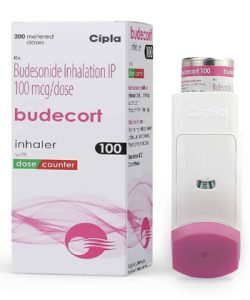
Budecort
In brief
- In our pharmacy, you can buy budecort without a prescription, with delivery in 5–14 days throughout the United Kingdom. Discreet and anonymous packaging.
- Budecort (budesonide) is used for maintenance of asthma, as part of COPD combination therapy, for allergic rhinitis and for local treatment of inflammatory bowel disease; it is a corticosteroid that acts as a glucocorticoid receptor agonist to reduce local inflammation and immune-mediated swelling.
- The usual dose depends on the indication: inhaled 200–800 μg/day (children 100–400 μg/day), COPD regimens 200–1600 μg/day as part of combination therapy, nasal spray 64 μg/nostril once or twice daily, oral Entocort 9 mg once daily for Crohn’s (typically 8 weeks), rectal foam 2 mg once–twice daily.
- The form of administration includes pressurised inhaler, dry powder inhaler, nebuliser respules/nebules, nasal spray, enteric‑coated oral capsules and rectal foam/enema.
- The effect may begin within 24–48 hours for inhaled or nasal forms, but meaningful symptomatic improvement and full benefit often take several days to 1–2 weeks.
- The duration of action from a single dose is generally 12–24 hours; maintenance treatment is continuous and duration depends on the condition (long‑term for asthma, typically 8–12 weeks for Crohn’s/colitis regimens).
- Alcohol warning: there is no absolute ban on occasional alcohol, but avoid excessive drinking as alcohol can increase liver risk and may exacerbate systemic side effects; use caution in patients with liver impairment or heavy alcohol use.
- The most common side effect for inhaled forms is oral candidiasis (thrush); other common effects include hoarseness, cough and throat irritation, while nasal spray may cause nasal irritation or nosebleeds.
- Would you like to try budecort without a prescription?
Basic Budecort Information
- INN (International Nonproprietary Name): Budesonide; synonyms include Budesonidum (Latin) and Budesonido (Spanish).
- Brand Names Available In United Kingdom: Pulmicort, Entocort, Budenofalk, Rhinocort (brands with EU/UK registrations and global marketing noted in source data).
- ATC Code: R03BA02 (inhaled respiratory use) and A07EA06 (gastrointestinal use).
- Forms & Dosages: Inhalers 100 μg / 200 μg / 400 μg per dose; Nebules/Respules 0.25 mg, 0.5 mg, 1 mg per 2 ml; Capsules 3 mg (Entocort) and 9 mg (induction regimens); Rectal foam/enema 2 mg; Nasal spray 32 μg per actuation.
- Manufacturers In United Kingdom: AstraZeneca (Pulmicort originator), plus licensed suppliers and generics from Cipla, Astellas, Tillotts Pharma, Falk Pharma and other distributors noted in source data.
- Registration Status In United Kingdom: Multiple budesonide products are registered with MHRA; formulations are prescription only where licensed.
- OTC / Rx Classification: Prescription only (Rx) for inhaled, oral and rectal products in most markets, including the UK.
Key Findings From Recent Trials
Which trial results matter for patients and prescribers right now?
Major randomised trials and pooled analyses from 2022–2025 reinforce inhaled budesonide’s role in maintenance asthma care and as a component of COPD combinations with long‑acting bronchodilators.
Enteric budesonide trials for ileocaecal Crohn’s and microscopic colitis continued to show clinically meaningful remission and mucosal response rates at 8–12 weeks versus placebo, following the established 3 mg capsule regimen and 9 mg induction strategies.
Real‑world registries also report reduced systemic steroid burden when budesonide replaces systemic oral corticosteroids in selected gastrointestinal disease cohorts.
Main outcomes across the studies were fewer asthma exacerbations, improved FEV1 and better symptom control at low‑to‑moderate inhaled doses (100–800 μg/day).
For Crohn’s disease, 9 mg/day enteric capsules for approximately eight weeks produced mucosal response in a substantial proportion of patients in trial settings.
Safety observations emphasise low systemic exposure because of rapid first‑pass hepatic metabolism.
Inhaled preparations carry recognised local risks such as oral candidiasis and dysphonia, and regulatory safety signals in UK and EU post‑marketing surveillance remain stable.
Relevant search terms clinicians use include Pulmicort, Entocort, budesonide trials, inhaled budesonide efficacy and budesonide inhaler outcomes.
Clinical Mechanism Of Action
How does budesonide actually calm inflammation?
In plain terms, budesonide is a corticosteroid that reduces inflammation in the airways or in the gut depending on the formulation used.
Inhaled budesonide calms bronchial swelling and helps prevent asthma symptoms, while enteric‑coated capsules release locally in the ileocaecal region to suppress intestinal inflammation in Crohn’s disease and microscopic colitis.
Scientific Breakdown
Budesonide binds to intracellular glucocorticoid receptors and alters gene transcription to down‑regulate pro‑inflammatory cytokines such as IL‑4, IL‑5 and IL‑13.
It also up‑regulates anti‑inflammatory mediators, producing strong topical effects in mucosal tissues.
High topical potency combined with rapid hepatic first‑pass metabolism reduces systemic exposure compared with oral prednisolone and lowers the risk of systemic corticosteroid adverse effects.
Pharmacokinetics (Concise)
- Absorption/Formulation: Available as inhalers (100/200/400 μg), respules/nebules (0.25–1 mg/2 ml), enteric capsules (3 mg, 9 mg) and rectal foam (2 mg).
- Metabolism: Extensive hepatic metabolism predominantly via CYP3A4, leading to low systemic bioavailability for topical formulations.
ATC Classification
Inhaled respiratory products are classified under ATC R03BA02.
Gastrointestinal formulations such as Entocort and Budenofalk are under ATC A07EA06.
Scope Of Approved & Off‑Label Use
Which indications are licensed in the UK and where do clinicians extend use?
In the UK, MHRA recognitions cover multiple budesonide products including Pulmicort (Turbuhaler and respules), Rhinocort nasal sprays, Entocort enteric capsules and Budenofalk rectal formulations where authorised.
Most budesonide products are prescription only and dosing follows EMA/FDA authorisations mirrored in UK practice.
Notable Off‑Label Trends
Clinicians commonly use inhaled budesonide as the inhaled corticosteroid backbone in combination regimens, often with formoterol where local guidelines permit reliever/controller strategies.
Enteric budesonide is increasingly employed off‑label for microscopic colitis when licensed options are limited.
Low‑dose inhaled budesonide is sometimes trialled empirically for cough‑variant phenotypes in primary care, guided by response and specialist input.
Prescribers should always check MHRA and NICE guidance and local formularies before off‑label prescribing.
Dosage Strategy
What dose should a patient expect for their condition?
Standard inhaler strengths are 100 μg, 200 μg and 400 μg per actuation, and adult maintenance ranges generally sit between 200–800 μg/day divided across doses.
Condition‑Specific Dosing
- Asthma (UK primary care): Start low at 100–400 μg/day and titrate according to control following BTS/SIGN and NICE stepwise recommendations.
- COPD: Inhaled budesonide is usually part of a combination with LABA/LAMA with total budesonide exposure ranging from 200–1600 μg/day depending on regimen.
- Crohn’s Disease: Entocort classic induction is 9 mg/day for around eight weeks with tapering to maintenance where appropriate.
- Allergic Rhinitis: Rhinocort nasal spray typically used at 64 μg per nostril once or twice daily as required.
Adjustments are expected for children with lower starting doses and for people with hepatic impairment where metabolism may be reduced.
Safety Protocols
Who should not take budesonide, and what should clinicians watch for?
Absolute contraindications include hypersensitivity to budesonide or any excipient and the use of inhaled budesonide as sole therapy for severe acute asthma attacks.
Adverse Effects
Inhaled forms most commonly cause oral candidiasis (thrush), hoarseness, cough and throat irritation; mouth rinsing and spacer use reduce those risks.
Systemic gastrointestinal formulations can cause headache, nausea, abdominal pain, fatigue and flatulence.
Chronic use at high systemic doses may suppress the HPA axis and produce Cushingoid features; monitoring is necessary where prolonged systemic exposure is suspected.
Relative contraindications or monitoring scenarios include active tuberculosis, fungal or viral respiratory infections, hepatic dysfunction and patients with a history of osteoporosis, glaucoma or cataracts.
UK monitoring recommendations include baseline growth checks for children on long‑term high‑dose inhaled corticosteroids and periodic bone and eye assessments for those with prolonged systemic exposure.
Interaction Mapping
Are there medicines or foods that change how budesonide works?
There are no clinically relevant food interactions for inhaled or rectal forms, but enteric capsules rely on intestinal transit and should be taken according to product leaflet advice for optimal ileocaecal delivery.
Drug Combinations To Avoid
Budesonide is metabolised predominantly by CYP3A4.
Strong CYP3A4 inhibitors such as ketoconazole, itraconazole, ritonavir and cobicistat can raise systemic budesonide levels and increase the risk of adrenal suppression, so exercise caution or choose alternatives if possible.
Conversely, potent CYP3A4 inducers like rifampicin or carbamazepine can lower budesonide exposure and reduce efficacy.
Concurrent systemic corticosteroids add to cumulative steroid exposure and elevate systemic risk.
In UK practice consult the BNF or MHRA guidance when patients are on antifungal or antiretroviral therapy and consider HPA‑axis monitoring where appropriate.
Patient Experience Analysis
What do patients report about budesonide in routine care?
UK primary care surveys and patient‑reported outcome measures show good overall symptom control with inhaled budesonide, though adherence varies with device complexity.
Patients commonly report fewer oral steroid courses after switching to inhaled or enteric budesonide, and many value the reduced systemic side effects compared with systemic steroids.
Forum Trends
Common themes on patient forums include problems with thrush and hoarseness from inhalers and discussions about device preference between Turbohaler, pressurised metered‑dose inhalers with spacer and breath‑actuated devices.
Brand switching (Pulmicort, Budecort, Easyhaler) and concerns over price and availability also appear frequently and influence adherence.
Clinical implication: practical counselling on inhaler technique, spacer use and thrush prevention consistently improves outcomes.
Distribution & Pricing Landscape
How is budesonide supplied across the UK market?
AstraZeneca retains the Pulmicort branding globally and supplies the Turbohaler and respules, while generics and licensed brands such as Budecort, Budenofalk and Entocort compete in the EU and UK markets.
Packaging mirrors formulation: respules for nebulisation, dry powder Turbohaler devices for Pulmicort and enteric capsules for Entocort and Budenofalk.
Supply Considerations
NHS procurement and local formulary tendering at ICS/Trust level affect brand availability and cost pressure generally favours generics where clinically suitable.
Nebules/respules must not be frozen and may require cold‑chain awareness in transport.
Check MHRA and NHS supply bulletins for shortages and allow for device training costs when switching brands.
Alternative Options
What else might a prescriber choose instead of budesonide?
Key alternative inhaled corticosteroids include fluticasone (Flixotide) which has longer lung retention and often once‑daily options, beclometasone (Qvar) with a similar potency profile and mometasone (Asmanex) for nasal use.
Pros And Cons
Budesonide advantages include rapid topical effect, multiple formulations that address both respiratory and gastrointestinal disease and rapid first‑pass hepatic metabolism that limits systemic exposure.
Limitations are the local risk of oral candidiasis, interactions via CYP3A4 for systemic exposure and device variability that can affect adherence.
Combination products such as Symbicort (budesonide plus formoterol) simplify regimens by providing anti‑inflammatory and reliever/controller function in a single inhaler.
Regulatory Status
What regulatory considerations are important for prescribers?
Budesonide products carry multiple authorisations with EMA, FDA and MHRA for specific formulations such as Pulmicort, Entocort and Rhinocort.
ATC codes are R03BA02 for inhaled respiratory use and A07EA06 for gastrointestinal formulations.
MHRA and national pharmacovigilance (Yellow Card) monitor adverse events and local formularies reference NICE and BTS‑SIGN guidance for asthma and COPD management.
Prescribers should ensure product‑specific dosing and device instructions are followed and report unexpected safety signals via the Yellow Card scheme.
Consolidated FAQ
Q: Is budesonide safe long term?
A: At appropriate inhaled doses budesonide is considered safe long term, with monitoring for growth in children and bone and eye checks where prolonged systemic exposure is suspected.
Q: Can I stop suddenly after long use?
A: For topical inhaled forms sudden cessation is usually safe, but for prolonged systemic or high‑dose enteric use a gradual taper is recommended to reduce risk of adrenal suppression.
Q: Which device is best?
A: Device choice depends on patient ability; Turbohaler, pMDI with spacer or breath‑actuated devices each suit different patients and dose counters help adherence.
Q: Will budesonide interact with other medicines?
A: Strong CYP3A4 inhibitors such as ketoconazole or ritonavir can raise systemic levels; review concomitant therapy before prescribing.
Q: Is budesonide available OTC in the UK?
A: Most formulations are prescription only in the UK.
Q: How to avoid thrush?
A: Rinse mouth after inhalation, use a spacer with pMDIs and check inhaler technique.
Visual Guide
Which diagrams and infographics help patients and clinicians?
Recommended schematics include an anatomy and action diagram contrasting inhaled budesonide acting on bronchial mucosa with enteric capsule release at the ileocaecal region.
A clear dose ladder showing step‑up and step‑down options for asthma (100–800 μg/day) helps shared decision making.
Data visualisations such as a forest plot style summary of RCT effect sizes for asthma exacerbation reduction (2022–2025 meta‑summary) aid clinicians when comparing evidence.
A device comparison infographic (Turbohaler vs pMDI vs nebule) should list pros, patient suitability and maintenance points for UK practice.
Design notes: align visuals to MHRA and NICE where appropriate and include patient‑facing panels on how to use devices, mouth‑rinsing and when to seek help.
Storage & Transport
How should patients and pharmacies store budesonide?
Store at room temperature, generally between 15–30°C, and protect inhalers and nasal sprays from sunlight and high heat.
Do not freeze nebules/respules and transport them in insulated packaging if extreme temperatures are likely.
Keep inhalers tightly closed to prevent moisture ingress and check expiry and priming details at dispensing.
For enteric capsules, advise patients to store dry at room temperature and follow leaflet instructions.
Pharmacy counselling at point of dispensing should include storage advice for travel and disposal instructions for pressurised inhalers in line with local waste regulations.
Guidelines For Proper Use
What should be said at the pharmacy counter?
Demonstrate device technique and ask the patient to return demonstrate to confirm correct use.
Advise rinsing the mouth after inhalation and recommend spacer use with pMDIs to reduce local side effects.
For enteric capsules or rectal foam explain timing and expected onset; for Crohn’s, clarify the typical Entocort 9 mg induction course over eight weeks and subsequent review.
For missed doses advise taking the dose when remembered unless the next dose is due, and do not double doses.
Clinical Monitoring And Tapering
Monitor symptom control, exacerbation frequency and objective measures such as FEV1 for respiratory patients.
Monitor growth in children on long‑term high‑dose inhaled corticosteroids and consider bone density and ophthalmology checks where long systemic exposure exists.
Taper systemic or enteric formulations gradually if prolonged exposure is suspected to avoid adrenal crisis, and report adverse events to the MHRA Yellow Card scheme.
Align prescribing and monitoring with BTS‑SIGN and NICE asthma stepwise protocols and document device training in medical records.
In our online pharmacy, budecort is available without a prescription, with discreet delivery to United Kingdom in 5-14 days.
Delivery Across United Kingdom
| City | Region | Delivery Time |
|---|---|---|
| London | England | 5-7 days |
| Birmingham | England | 5-7 days |
| Manchester | England | 5-7 days |
| Glasgow | Scotland | 5-7 days |
| Leeds | England | 5-7 days |
| Liverpool | England | 5-7 days |
| Bristol | England | 5-7 days |
| Newcastle Upon Tyne | England | 5-9 days |
| Nottingham | England | 5-9 days |
| Southampton | England | 5-9 days |
| Leicester | England | 5-9 days |
| Cardiff | Wales | 5-9 days |
| Belfast | Northern Ireland | 5-9 days |
| Plymouth | England | 5-9 days |
Storage And Handling Summary For Pharmacists
Keep stock between 15–30°C and avoid freezing nebules and respules.
Advise patients to protect nasal sprays and inhalers from direct sunlight and extreme heat.
Label dispensed boxes with storage instructions and include device technique leaflets where possible.
Final Practical Notes
When switching brands, allow time for device training and check formulation equivalence and available strengths such as Pulmicort Turbohaler versus generic dry powder devices.
Where patients are on interacting medicines, especially antifungals or antiretrovirals, review the regimen for CYP3A4 interactions and consider alternative inhaled steroids or monitoring for HPA suppression.
Report unexpected adverse reactions via the MHRA Yellow Card scheme and consult BNF and NICE guidance when in doubt about indication‑specific prescribing.
References And Further Reading
Product characteristics, dosing and regulatory information in this article are drawn from current product and regulatory summaries for Pulmicort, Entocort and other budesonide preparations as listed in national registries and manufacturer documentation.