Loniten
Loniten
- Loniten (minoxidil) can be purchased from prescription-only pharmacies and licensed suppliers in markets where it is approved; however, availability is limited because the brand is discontinued in the US and it is generally supplied as generic minoxidil in the UK, EU, Australia, and other regions. Although some pharmacies may offer it, it is legally classified as prescription only medicine and should normally be obtained with a valid prescription.
- Loniten is used for the treatment of severe, resistant high blood pressure that has not responded adequately to other medicines. It is a potent peripheral vasodilator that relaxes blood vessel smooth muscle, helping to lower blood pressure; it is usually given with a loop diuretic and a beta-blocker to reduce fluid retention and fast heart rate.
- The usual starting dose in adults is 5 mg daily, given as a single dose or divided doses, then increased gradually every few days according to response. Maintenance doses are commonly 10–40 mg daily, and the maximum dose may reach 100 mg daily in specialist use.
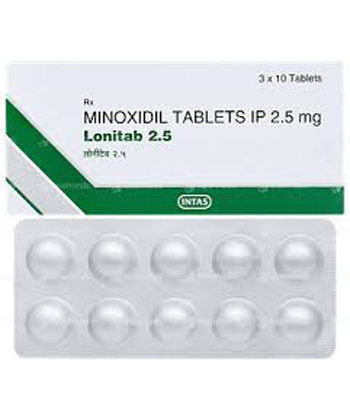
- The form of administration is an oral tablet, commonly available in 2.5 mg and 10 mg strengths, with some regions supplying other tablet strengths.
- It usually begins to lower blood pressure within a few hours after dosing, though the dose may need to be adjusted over several days before the full clinical effect is seen.
- The duration of action is roughly 24 hours, so it is generally taken once or in divided doses each day under ongoing medical supervision.
- Alcohol should be avoided or limited, as it can increase dizziness, low blood pressure, and faintness.
- The most common side effects are fluid retention or swelling, increased hair growth (hypertrichosis), fast heartbeat or palpitations, headache, and dizziness.
- Would you like to try Loniten without a prescription?
Loniten
Basic Loniten Information
- INN (International Nonproprietary Name): Minoxidil
- Brand Names Available In United Kingdom: Minoxidil (various brands), generic only
- ATC Code: C02DD01
- Forms & Dosages: Oral tablets, mainly 2.5 mg and 10 mg
- Manufacturers In United Kingdom: Various generic suppliers
- Registration Status In United Kingdom: Approved generics only by the MHRA
- OTC / Rx Classification: Prescription only medicine (Rx); not available over the counter
- Standard Dosage Per Condition: Adults with severe or refractory hypertension usually start at 5 mg daily, then titrate every 3 days as tolerated up to 40 mg daily in divided doses; some references allow a maximum of 100 mg daily
- Storage And Transport: Store below 25°C in a dry place in the original packaging; protect from moisture and light; transport at controlled room temperature
What Recent Evidence Tells Us About Oral Minoxidil
Are you looking at loniten because blood pressure has stayed high despite several other tablets?
That is the setting where oral minoxidil still earns a place, and nowhere else in routine care.
Recent practice reviews from 2022 to 2025 continue to describe it as a specialist medicine for severe, refractory hypertension rather than a drug for everyday first-line use.
The reason is simple enough for patients to understand at the kitchen table.
It can lower blood pressure strongly when standard combinations have not done the job, but the price is tolerability.
Fluid retention, fast heart rate, and swelling are the problems that most often limit use, so contemporary prescribing is shaped as much by safety surveillance as by efficacy.
That is why minoxidil for hypertension remains a secondary-care medicine in the UK, usually started by a consultant when several standard agents have already been tried.
In practical terms, the best evidence still supports oral minoxidil as an add-on for difficult-to-control hypertension, not a first-line treatment for uncomplicated high blood pressure.
The key safety signals remain familiar across the literature.
Oedema, reflex tachycardia, and hypertrichosis are the dominant adverse effects.
Less common but more serious concerns include pericardial effusion and worsening heart failure, especially if the medicine is used without a loop diuretic and a beta-blocker.
That combination matters because it directly addresses the body’s compensation for vasodilation.
For UK patients, this means oral minoxidil is normally part of a tightly monitored plan rather than a simple repeat prescription.
How It Lowers Blood Pressure
Have you ever wondered why a tablet can help stubborn blood pressure but also make the body push back?
Minoxidil works by relaxing blood vessels so blood flows more easily and arterial pressure falls.
That is the lay version.
The scientific version is that minoxidil is a potassium channel opener and a vasodilator, with the ATC classification C02DD01.
Once arterioles relax, systemic vascular resistance drops.
In response, the body often reacts in ways that partly cancel the benefit.
Renin release increases, sodium and water are retained, and the sympathetic nervous system becomes more active.
That is why the medicine is reserved for hard-to-treat hypertension.
If it were used on its own, the compensatory response would often create more problems than it solves.
In ordinary language, the medicine opens the pipes, but the body starts holding on to salt and water and speeds the pulse up in response.
This haemodynamic pattern explains why co-treatment with a loop diuretic and usually a beta-blocker is standard practice.
In specialist care, that pairing is not optional background noise.
It is part of the pharmacology.
Patients sometimes hear only that loniten is “strong”, but the more important message is that its strength comes with predictable compensations that must be managed.
Where It Is Used In Practice
Is loniten something a GP would normally start in the surgery?
Usually not.
In the UK, oral minoxidil is prescription only and available as generic minoxidil, mainly in 2.5 mg and 10 mg tablets.
Its approved use is severe hypertension that has not responded to other medicines.
That means it sits in specialist secondary care rather than standard primary care pathways.
When people search for Loniten prescription information, they are often really asking whether this is a medicine they can obtain directly for chronic blood pressure control.
The answer is that it belongs in a consultant-led plan, with close follow-up.
One important distinction needs to be made very clearly.
Oral minoxidil must not be confused with topical minoxidil for alopecia.
Topical scalp products are a different formulation, a different indication, and a different risk profile.
The oral form has major cardiovascular risks and is strictly prescription only.
That distinction matters for safe counselling in pharmacy and for patients reading online about minoxidil tablets.
In our online pharmacy, loniten is available without a prescription, with discreet delivery to United Kingdom in 5-14 days.
Even so, the clinical reality remains unchanged.
This is a specialist medicine for severe hypertension, not a product to self-start casually, and patients should understand exactly why it was chosen.
How The Dose Is Usually Set
Worried that a strong blood pressure medicine means a complicated dosing schedule?
With minoxidil tablets for hypertension, careful titration is the rule.
The usual adult starting dose is 5 mg daily, given as a single dose or divided.
If tolerated, the dose can be increased every 3 days.
Typical titration goes up to 40 mg daily in divided doses.
Some references allow a maximum of 100 mg daily, but that is specialist territory.
The point of slow titration is to balance benefit against fluid retention and tachycardia.
That is why dose changes are not made lightly.
For severe or refractory hypertension, the response is often judged over days rather than weeks, but the monitoring never stops.
Elderly patients should start at the lower end of the range and be titrated more slowly.
Renal impairment and dialysis also call for caution and lower doses where needed, because fluid and electrolyte disturbances can be more difficult to control.
Children are not routinely treated with oral minoxidil, and specialist paediatric advice is required if it is ever considered.
The main practical message is straightforward.
Do not compare oral minoxidil dosing with over-the-counter medicines or topical products.
Loniten 2.5 mg tablets and Loniten 10 mg tablets are used in a monitored antihypertensive regimen, not as a casual tablet to “try and see”.
What Safety Checks Matter Most
Are side effects the reason this medicine is reserved for specialists?
They are a big part of it.
Minoxidil side effects commonly include fluid retention, oedema, tachycardia, palpitations, headache, dizziness, and hypertrichosis.
The hair-growth effect can be especially noticeable on the face and arms.
For some patients, that becomes the deciding factor in whether they continue treatment.
More serious problems need urgent attention.
Pericardial effusion and worsening heart failure are the major red flags.
Those risks are especially important if the medicine is used without the usual companion medicines.
A loop diuretic is normally required to control salt and water retention.
A beta-blocker is usually required to reduce reflex tachycardia.
This is why minoxidil for high blood pressure is rarely prescribed in isolation.
Contraindications also matter.
Pheochromocytoma is an absolute contraindication.
Known allergy to minoxidil or excipients is another.
Pregnancy and breastfeeding are not recommended because the medicine can cross the placenta and breast milk, with a risk of neonatal hypertrichosis.
Relative caution is needed in congestive heart failure, angina, recent myocardial infarction, renal impairment, liver disease, and in elderly or frail patients.
Monitoring should include blood pressure, pulse, weight, oedema, renal function, and symptoms such as chest discomfort or breathlessness.
If swelling appears around the ankles or weight rises quickly, that is not something to ignore.
Food, Interactions, And Companion Medicines
Do you need to avoid a special diet with this tablet?
There is no major clinically decisive food interaction at the centre of oral minoxidil use, but consistency matters.
Regular dosing, sensible hydration, and weight monitoring are more important than avoiding specific foods.
The interaction map is mainly about other medicines.
Minoxidil interactions are driven by its haemodynamic effects and the need to counter the body’s compensation.
The must-have combination is a loop diuretic, and usually a beta-blocker.
Without them, fluid retention and reflex tachycardia become much more likely.
Other antihypertensives can add to hypotension risk, so blood pressure should be checked carefully when regimens are changed.
In people with cardiac disease, close monitoring is essential.
That includes patients with angina, heart failure, or a recent myocardial infarction.
For prescribing teams, the real job is not just choosing loniten tablets.
It is building the right drug combinations around them.
That is why patients often leave a specialist appointment with several medicines, not just one.
What Patients Usually Notice
How do people actually feel once they start minoxidil tablets?
Patient experience is usually a trade-off between strong blood pressure benefit and tolerability.
When the medicine works well, people may notice their readings improve quite quickly.
That can be a relief after months of uncontrolled blood pressure.
At the same time, hypertrichosis is common and can affect adherence, especially if facial hair growth becomes visible.
Swelling and a racing pulse are also frequent themes in patient discussions.
In forums and clinic conversations, patients often describe oral minoxidil as a last-resort medicine prescribed by specialists.
That description is not wrong.
It reflects the fact that the drug is generally used after multiple standard agents have failed.
Some people accept the extra companion medicines without much complaint, while others find the regimen burdensome.
From a pharmacy perspective, the best results come when patients know what is expected.
If a person understands that oedema, palpitations, and hair growth can happen, they are more likely to report changes early rather than stopping treatment abruptly.
That improves adherence and safety.
Availability, Pack Sizes, And Pricing
Are Loniten suppliers and packaging easy to recognise?
In the UK and wider EU context, generic-only supply is the norm.
Oral tablets are commonly supplied in blister packs or bottles, often with tamper-evident packaging.
The common strengths are 2.5 mg and 10 mg.
Some markets also describe 5 mg presentations, and some references mention a 100 mg maximum dose, but UK dispensing is generally focused on the lower tablet strengths.
Brand history is worth knowing.
Loniten was the historical brand name in the United States, but that brand is discontinued there.
The active ingredient remains available generically, and that is the form most patients will encounter in the UK.
Pricing varies by generic supplier, pharmacy chain, and pack size.
That is normal for a generic medicine.
For patients, the important thing is that the pack clearly shows minoxidil, the strength, batch details, and the prescription-only status.
The packaging should also make it obvious that this is an oral tablet and not a topical scalp product.
That simple visual check prevents a lot of confusion at home.
How It Compares With Other Severe Hypertension Drugs
What are the alternatives if minoxidil is not suitable?
Several other severe hypertension drugs may be considered depending on the clinical picture.
Hydralazine is another oral vasodilator.
Clonidine is a central alpha-agonist sometimes used in resistant cases.
Sodium nitroprusside is an intravenous emergency option.
Diazoxide is another potassium channel opener used in hypertensive emergencies.
| Drug | Class | Usual Role |
|---|---|---|
| Minoxidil | Oral vasodilator, potassium channel opener | Severe or refractory hypertension |
| Hydralazine | Arteriolar vasodilator | Severe hypertension |
| Clonidine | Central alpha-agonist | Severe hypertension |
| Sodium nitroprusside | IV vasodilator | Hypertensive crisis or emergency |
| Diazoxide | K+ channel opener | Hypertensive emergencies |
Minoxidil’s strength is powerful blood pressure reduction when other regimens fail.
Its limitation is the burden of fluid retention and hirsutism compared with many alternatives.
That balance is exactly why specialist selection matters.
Regulatory Status And UK Position
Is minoxidil legal and approved in the UK?
Yes, but only as a prescription medicine.
The UK MHRA position is that generic minoxidil tablets are approved, not an over-the-counter product.
That is consistent with the medicine’s risk profile.
The US FDA historically approved Loniten for oral antihypertensive use, but the brand is discontinued and generics remain available.
Australia’s TGA registers it as prescription only, and the same general Rx-only principle applies across major markets.
Its ATC classification is C02DD01.
That places it in the antihypertensive vasodilator group.
Because oral minoxidil is not sold OTC in any major market, patients should treat it as a specialist medicine with regular follow-up rather than a self-care purchase.
For UK patients comparing options, that regulatory picture is often the clue that this is not a casual product, even if the tablet itself is small and simple in appearance.
Frequently Asked Questions
What is Loniten?
It is the brand name historically used for oral minoxidil, a medicine for severe hypertension.
Is it the same as topical minoxidil?
No.
Topical minoxidil is used for hair loss and has a different indication and risk profile.
Can oral minoxidil be used for hair loss?
That is a separate discussion and a different use case; this article is about the hypertension indication.
What happens if a dose is missed?
Take it as soon as remembered unless the next dose is near.
Do not double up.
What if too much is taken?
Overdose can cause severe hypotension, tachycardia, and fluid overload.
Urgent medical help is needed.
Is it available in 2.5 mg and 10 mg tablets?
Yes, those are the common oral tablet strengths in the UK and internationally.
Why is it combined with a diuretic and beta-blocker?
Because the body responds to vasodilation with salt and water retention and a faster pulse.
How To Store And Handle It Properly
Could poor storage make a difference with tablets like these?
Yes, the basics still matter.
Minoxidil storage should be below 25°C in a dry place, in the original packaging.
Protect the tablets from moisture and light.
When transporting them, controlled room temperature is the goal.
Do not decant tablets into unlabelled containers.
That makes batch checking and identification much harder.
Keep the pack away from children and check the expiry date before use.
These sound like ordinary pharmacy points, but they matter even more for prescription tablets that require careful long-term monitoring.
Delivery Across United Kingdom
| City | Region | Delivery Time |
|---|---|---|
| London | Greater London | 5-7 days |
| Birmingham | West Midlands | 5-7 days |
| Manchester | North West England | 5-7 days |
| Glasgow | Scotland | 5-7 days |
| Edinburgh | Scotland | 5-7 days |
| Leeds | Yorkshire and the Humber | 5-7 days |
| Liverpool | North West England | 5-7 days |
| Bristol | South West England | 5-7 days |
| Cardiff | Wales | 5-7 days |
| Belfast | Northern Ireland | 5-7 days |
| Sheffield | Yorkshire and the Humber | 5-9 days |
| Newcastle upon Tyne | North East England | 5-9 days |
| Nottingham | East Midlands | 5-9 days |
| Leicester | East Midlands | 5-9 days |
Final Practical Advice For Patients
If your clinician has chosen loniten, the reason is usually that your blood pressure has been hard to control with standard treatment.
That is exactly where this medicine belongs.
Used properly, oral minoxidil can be effective in refractory hypertension.
Used casually, it can cause avoidable problems.
The safest approach is to take it exactly as prescribed, keep the companion medicines in place, and attend follow-up checks for blood pressure, pulse, weight, and fluid retention.
If swelling, breathlessness, chest discomfort, or a fast pulse appears, that should be reported promptly.
That is how specialist treatment stays effective and safe over the long term.